
Feature Articles
#SLAExplains: Demystifying the Land Betterment Charge (LBC)
12 March 2026
Breaking down the LBC, who it affects and how it works
Land policies are the invisible hands shaping our country, organising the physical, social and economic spaces that we enjoy, but they often present layers of jargon. The Land Betterment Charge (LBC) is one such policy — often referenced but seldom explained in simple terms.
The Land Betterment Charge Act came into force on 1 August 2022. This landmark initiative consolidated various land charges under a single agency, the Singapore Land Authority (SLA), to make the entire process leaner and more streamlined for the parties involved.
In this instalment of #SLAExplains, we speak with Angel Chan, Director of Land Sale (Public) at SLA, to break down what the LBC really is, who it affects, and how it works in practice. We also explore how the new LBC Estimator on OneMap is making the system more transparent and predictable for landowners, businesses, and developers.

SLA’s Director of Land Sale (Public) Angel Chan explains the intricacies of the LBC
1. Let’s start with the basics. What is LBC?
At its simplest, the Land Betterment Charge, or LBC, is a charge on the increase in land value when land is allowed to be used in a more valuable way.
Think of it like this: If a piece of land was originally approved for one type of use, and later it’s allowed to be used for something more intensive or higher-valued, say, from industrial to commercial use or from low-rise to high-rise residential, the land becomes more valuable. The LBC applies to part of that increase in value.
2. Why call it “Land Betterment Charge”? What’s being “bettered”?
“Betterment” means the land is allowed to be better-utilised. That extra value doesn’t appear out of thin air. It comes from planning decisions, infrastructure, transport, and the way the city is designed and run.
3. Is LBC a new charge? Which agency is in charge of it?
The LBC isn’t a new concept. In terms of principles and how it is calculated— it’s largely the same as previous land enhancement levy regimes. What has changed is simplicity.
Previously, people had to navigate different charges — Development Charge, Temporary Development Levy, Differential Premium— handled by different agencies. Now, these have been consolidated into a single framework with one main point of contact— SLA. For landowners and developers, that means less confusion and fewer administrative steps.
In short, these charges have simply been brought together under the LBC framework.

The LBC rates are determined by the Chief Valuer, an independent office housed within the Inland Revenue Authority of Singapore (IRAS). Photo: IRAS
While SLA now administers the LBC, this arrangement maintains a robust set of checks and balances with a clear separation of roles. Planning decisions on how land can be used remain with the Urban Redevelopment Authority (URA).
The LBC Table of Rates are determined by the Chief Valuer and are intended to largely reflect land values in Singapore.
4. Why is LBC considered a charge on enhancement of land value? How does land value increase when planning permission or other consents are granted?
Land value can increase in a few common ways:
Change of use (for example, from industrial to residential)
Increase in intensity of use (for example, building higher)
Before any development happens, landowners or developers must obtain planning permission. When that permission allows the land to be used more intensively, and sometimes generate more revenue for the landowner, the land becomes more valuable. LBC applies to part of that increase.
5. Who does the LBC apply to? Who pays LBC?
The LBC applies when a development proposal results in an increase in land value — this applies to land developers and/or individual property owners and may include small business owners and SMEs.
The charge isn't limited to major commercial developments. It applies whenever planning permission is granted to allow land to be used more intensively or for a higher-value purpose, regardless of the scale. This could be a neighbourhood clinic expanding their facilities, a family business converting their shophouse for mixed residential-commercial use, or a small enterprise setting up a backpackers' hostel.
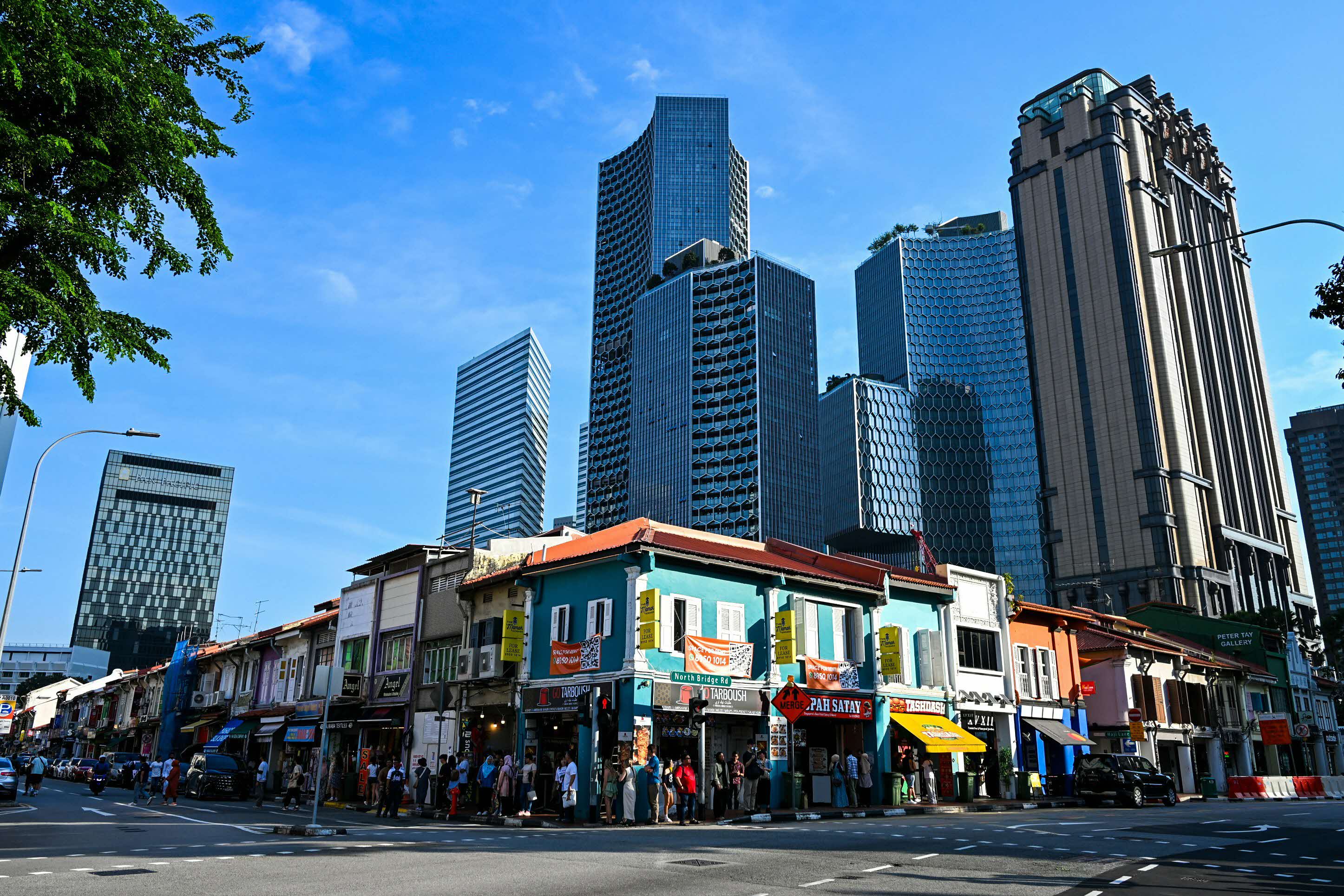
The LBC applies to both big developments and small SMEs
While the landowner is the default payee for the LBC, the system allows flexibility on who actually pays. If someone else — like a tenant — wants to take on the responsibility, they can do so by giving proper notice to SLA. This often happens when a tenant operator takes on the LBC liability as part of their lease arrangement with the landowner.
6. Some say that Singapore has one of the most robust land policies in the world. Can you explain how LBC fit into this picture?
Singapore has very limited land, so how we use it matters a lot.
LBC plays a role by:
Capturing part of the value created through planning decisions
Encouraging land to be used efficiently, not left under-utilised
Supporting long-term, sustainable urban development
The funds collected through LBC help support infrastructure, like transport networks, utilities, and public amenities, which in turn make developments viable and attractive in the first place.
7. From a fairness perspective, why is it reasonable for landowners to share the increase in land value created by planning permission?
Think about any development and its surrounding amenities. It sits within an existing area with roads, transport access, utilities, and nearby homes and shops already in place.
When planning permission is granted for a development which allows for higher intensity or a change of use, the developer benefits from the resulting enhancement in land value.
So from a fairness point of view, it’s reasonable that a portion of that gain is shared with the community, so the overall system continues to work well for everyone.
Understanding the Mechanics
8. How is the LBC amount calculated?
For most cases, it's quite predictable. Most of LBC is computed using the Table of Rates method, which works like a pricing menu based on two simple things: where your land is and what you want to do with it.
Think of it this way - land in Orchard Road will have different rates compared to land in Jurong, just like how a coffee costs more in the city centre than in the heartlands. Similarly, building a shopping mall will attract different rates compared to building a warehouse, because they generate different levels of value.
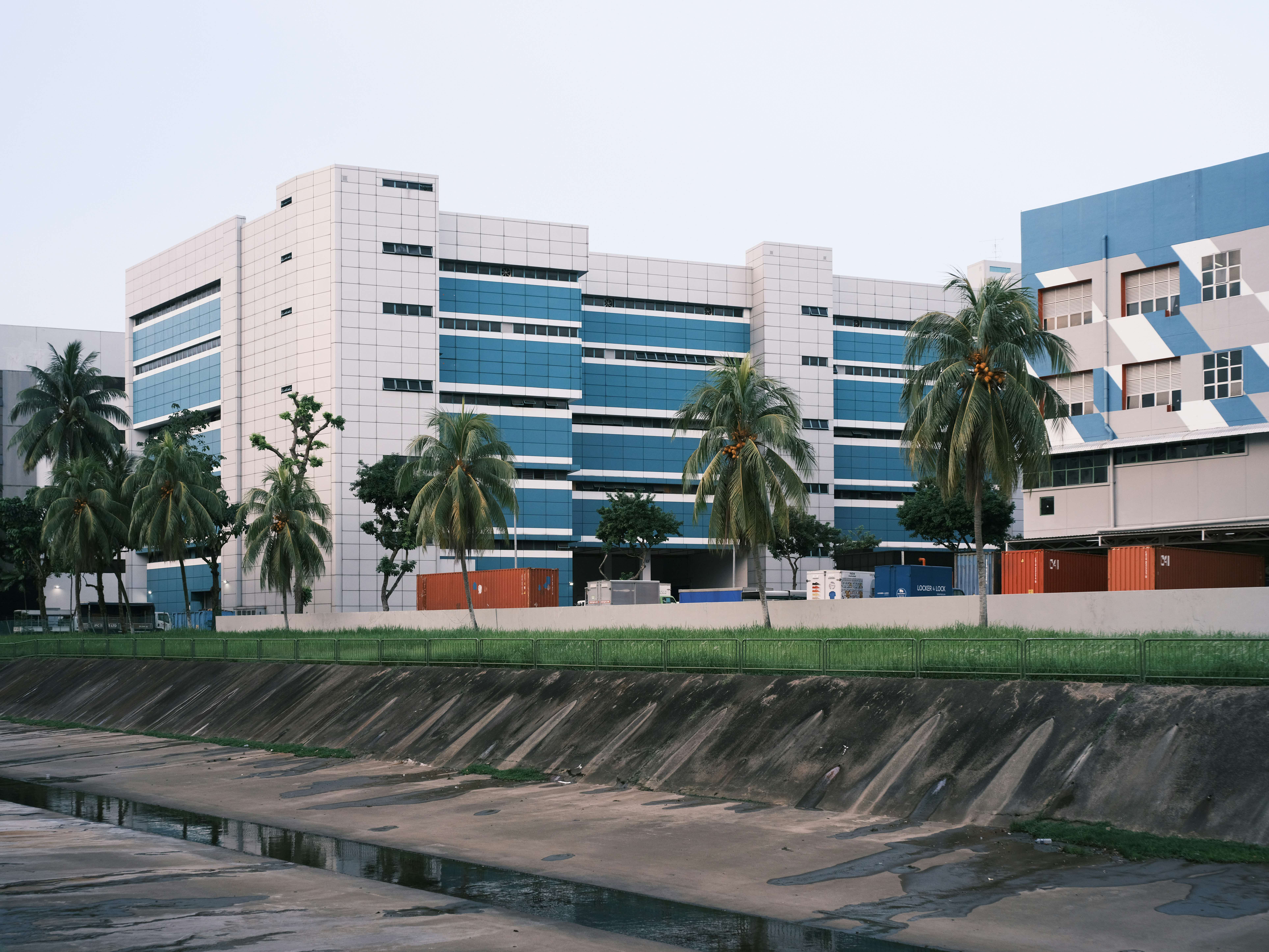
Building a mall will have different rates compared to building a warehouse as they generate different levels of value
The Table of Rates is updated and published twice a year – in March and September, so the rates stay current with market conditions. This means developers can estimate costs early based on their own indicative calculations, even before finalising plans.
And now there’s the LBC Estimator, an online calculator hosted on OneMap developed by SLA, that has built-in elements to make the calculation of potential LBC simpler and faster. You can type in an address and proposed Gross Floor Area/proposed usage and try different scenarios, like: “What if I add two more floors?” “What if I change from factory to showroom?" The estimated LBC payable for the period of enhancement to the property will automatically show.
That upfront visibility really helps with financial considerations.
9. Any other methods to calculate LBC other than using Table of Rates?
While the Table of Rates provide for predictability and consistency in most situations, there’s flexibility in that a taxable person can choose spot valuation in lieu of using the Table of Rates method so that site-specific attributes can be taken into consideration in the LBC valuation. This option involves a professional assessment by a designated valuer. If opted for, it’s irrevocable, i.e. you will no longer be able to choose to pay LBC computed using the Table of Rates.
Spot valuation will also apply in specific circumstances where the Table of Rates might be inapplicable, such as where there is either no suitable or no comparable LBC use group for assessment.
10. Any other little-known facts about LBC?
One thing many people don’t realise is that LBC is not a 100% charge on the value increase.
In most cases, LBC is calculated at about 70% of the enhancement in land value. So landowners keep a 30% share of the uplift. It is not about taking everything from the landowners but rather, sharing the upside.
Only in very exceptional situations would the full enhancement be charged, and those are the exceptions, not the norm.
So, in practice, LBC already reflects a kind of built-in sharing arrangement, rather than a full clawback.
Introduction of the LBC Estimator on OneMap
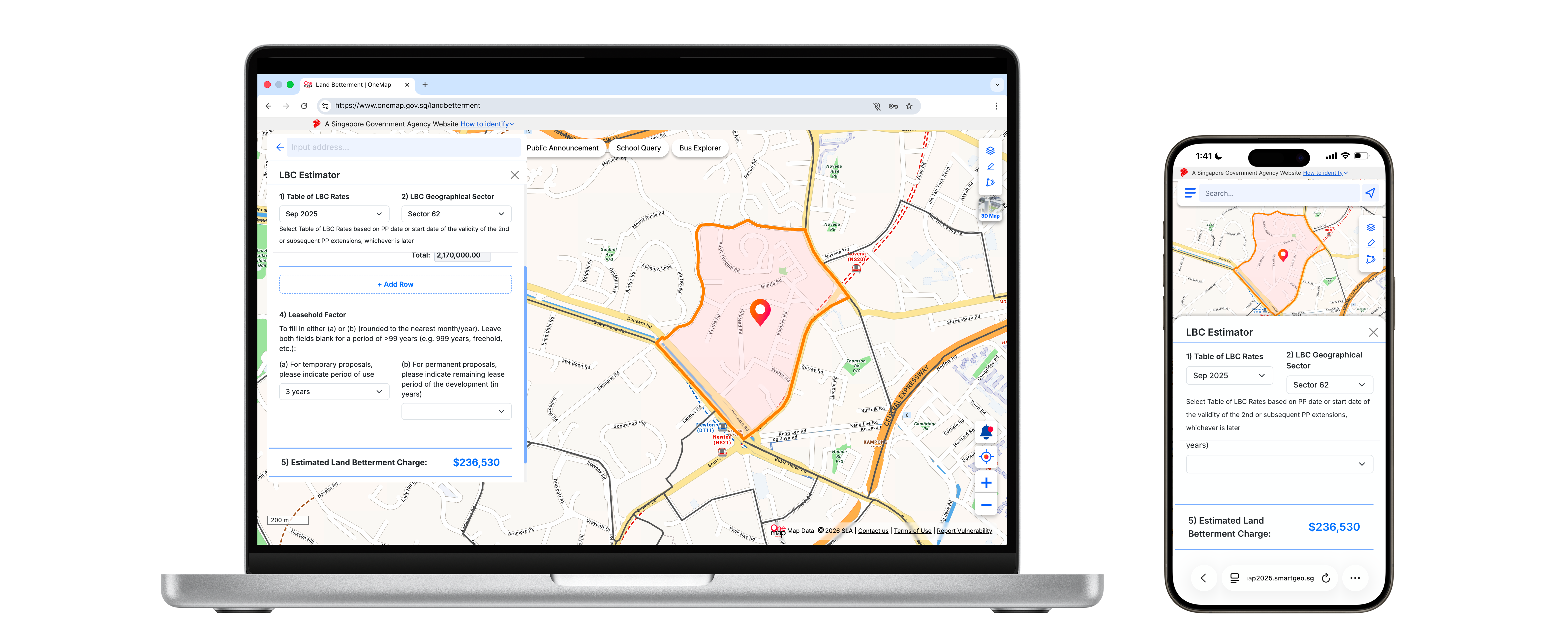
The new LBC Estimator enables users to independently estimate the LBC payable for development proposals upfront
11.With the launch of the LBC Estimator on OneMap, how much easier is it now for the public to gauge their potential LBC?
It removes guesswork. Before, people might only find out the cost in the advanced stage of the development process. Now, you can check upfront, run a few “what if” scenarios, and decide whether the project makes financial sense. That’s especially helpful for SMEs and first-time developers.
We’ve received very encouraging feedback from industry practitioners who find the LBC Estimator intuitive.
For instance, Mr Png Poh Soon, Executive Director and Head of Valuation & Advisory Services at CBRE shared with us that as a regular user of OneMap, the familiar interface is quite reassuring. He noted that the built-in checklist provides clear guidance on whether LBC applies and offers a quick assessment of the amount payable on the site. He finds it particularly handy for those who aren’t yet familiar with the LBC rates mechanism but need a guided tool to navigate it.
We also see the tool benefitting different users in different ways. Dr Lee Nai Jia, a real estate futurist previously from the PropertyGuru Group, observed that the Estimator benefits real estate agents marketing a property or advising their clients and for landowners looking for a quick indication of value. For asset owners, it will be useful for making informed decisions on asset enhancement.

Mr Png Poh Soon (left) and Dr Lee Nai Jia found the LBC Estimator handy for those not familiar with the LBC rates mechanism and landowners looking for a quick indication of value
12.What was the motivation behind introducing this tool? How does it benefit the various groups of stakeholders?
Uncertainty is costly. That’s why if businesses know the numbers early, they can plan better, avoid surprises, and move faster.
Ultimately, it's about early feasibility. As Poh Soon pointed out, practitioners can use the estimator as a tool to decide if a site they are reviewing has development potential and to estimate the probable price or value. That kind of early visibility helps everyone in the ecosystem make more informed, confident decisions.
For different stakeholders, the benefits vary: developers can run multiple scenarios before finalising their plans, business owners expanding their premises can budget accurately from the start, property owners considering enhancements get immediate cost estimates, and potential investors can factor LBC into their investment calculations upfront rather than discovering costs later in the process.
Clearing Up Common Misconceptions
13. For small businesses, the LBC can feel like a heavy upfront cost. How does LBC try to balance encouraging land optimisation with protecting the public’s interest?
We do recognise that it can feel heavy upfront. Where a business is genuinely testing an idea, temporary permissions could be an option, and the LBC is adjusted to match the shorter time frame. That gives businesses room to experiment without committing as if it was a permanent change. Not all temporary permissions will require the payment of LBC — it applies only in instances where there is an enhancement in land value arising from the temporary use.

Temporary permissions can offer flexibility for some businesses, with the LBC tailored to a shorter timeframe
14. Is there concessionary relief? Under what conditions can owners get exemptions or reduced charges?
Yes, there are provisions to exempt or provide concessionary relief for LBC. Some projects qualify for exemptions or concessionary rates, especially where they support broader goals like conservation or community use.
One example is the Golden Mile Complex, whose developer was granted a concessionary relief in 2024 to support and incentivise the conservation of the Golden Mile Complex.
There’s flexibility to ensure land policies support good outcomes, not just revenue.

Golden Mile Complex was granted a concessionary relief in 2024 to facilitate its conservation
Closing
15. Let’s end with this: If you had to explain LBC to your grandmother or a coffeeshop uncle in 30 seconds, what would you say?
I’d say: If your land is allowed to do more and earn more, its value goes up. This increase in value is shared with the community. The LBC goes back to to improve public infrastructure such as roads, MRT, and facilities. If nothing changes, you don’t pay. It’s about distributing the upside for your next generation.

Coffee shop talk: If your land can do more and earn more, it’s worth more and part of that uplift goes back to the community
#SLAExplains is a thought leadership series where SLA senior management breaks down complex land and geospatial concepts into accessible insights for the public. The series reflects SLA's commitment to transparency and public education, helping Singaporeans better understand the systems and policies that shape our nation's development.
Glossary of Key Terms
Term | Definition |
|---|---|
Chief Valuer (CV) | An independent office located at the Inland Revenue Authority of Singapore (IRAS). The LBC rates are reviewed on a half-yearly basis in consultation with the Chief Valuer. |
Table of Rates | A published schedule of LBC rates based on location and approved land use, updated twice yearly. |
Spot Valuation | A professional valuation of enhancement in land value conducted for specific cases where the Table of Rates does not apply (such as where there is either no suitable or no comparable use group for assessment) or where the taxable person elects this option (in lieu of using the Table of Rates method). |
Enhancement in Land Value | The increase in land value arising from planning permission or lifting of land title restrictions that allow more intensive or higher value use. |
If your land is allowed to do more and earn more, its value goes up. This increase in value is shared with the community. The LBC goes back to to improve public infrastructure such as roads, MRT, and facilities. If nothing changes, you don’t pay. It’s about distributing the upside for your next generation.— Angel Chan