#SLAExplains: Introducing the new Digital Conveyancing Portal (DCP)
Making property transactions simpler, safer, and smarter

Behind the DCP: Meet the SLA team leading the digital transformation of conveyancing, towards a fully paperless, end-to-end process
Buying or selling a property is often one of life’s major milestones. But behind every defining transaction is a process most people never quite see – conveyancing, a process that has, for decades, run largely on paper. In fact, it is how the name came about in the first place – to convey something, in this case, documents, from A to B.
Behind the scenes today, the transaction involves law firms, banks, real estate agents and government agencies exchanging documents, payments and updates in order for a property transaction to be completed and transfer the legal ownership from the legitimate seller to its rightful buyer. Cheques are issued and banked. Signatures are inked, scanned, and re-sent. It works, but is cumbersome, and every manual handover is a point where potentially something may backtrack the process – perhaps a missing or inexact signature, a misplaced document, or a delayed cheque.
The DCP aims to bring the full conveyancing journey together digitally, making it simpler to navigate, easier to track and less reliant on paper and manual handovers across all stakeholders involved in the current process.
That's the process that the DCP will change.
In this instalment of #SLAExplains, Foo Siang Larng, Director, Land Titles Registry and Orson Zhu, Senior Deputy Director, Land Titles Registry at SLA - the team managing DCP transformation efforts break down what DCP actually is, what it means for buyers and sellers, and the various stakeholders involved in a property transaction, share how the portal will progressively develop in the future and how one can kick start the process — starting with the portal's first real-world outing: the pilot launch covering the Option to Purchase (OTP) stage.
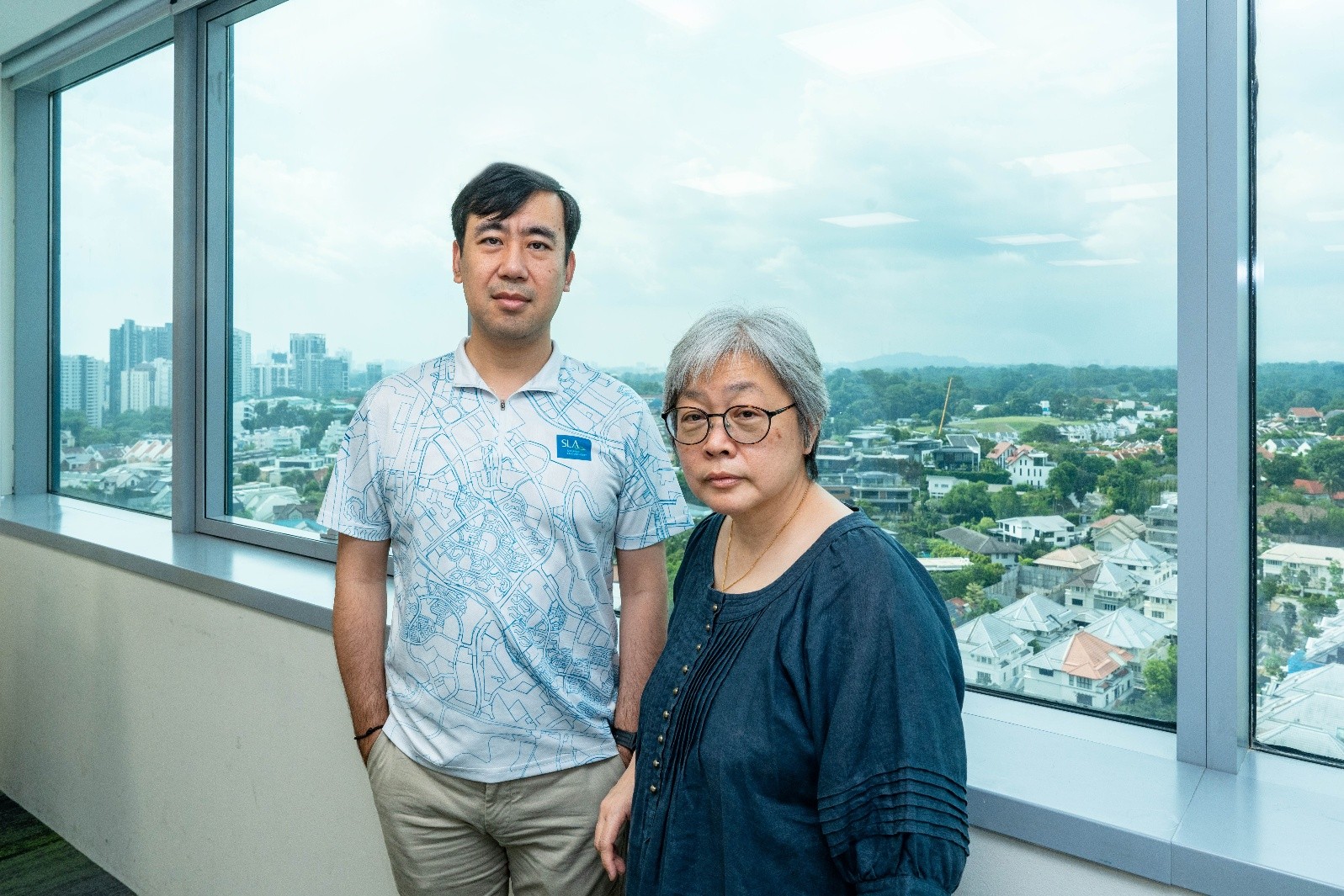
SLA's Foo Siang Larng, Director (right), and Orson Zhu, Senior Deputy Director, Land Titles Registry, share how the portal is set to transform the way property transactions are carried out in Singapore.
The Basics
1. What exactly is the Digital Conveyancing Portal (DCP)?
Siang Larng: The DCP is a secure, government-developed online platform that lets all parties in a property transaction — lawyers, buyers, sellers, banks, real estate agents and government agencies — carry out conveyancing steps digitally, instead of over paper, phone calls and physical cheques. Think of it as a shared digital folder for the entire transaction: documents, payments, statuses, all moved electronically rather than as physical material.
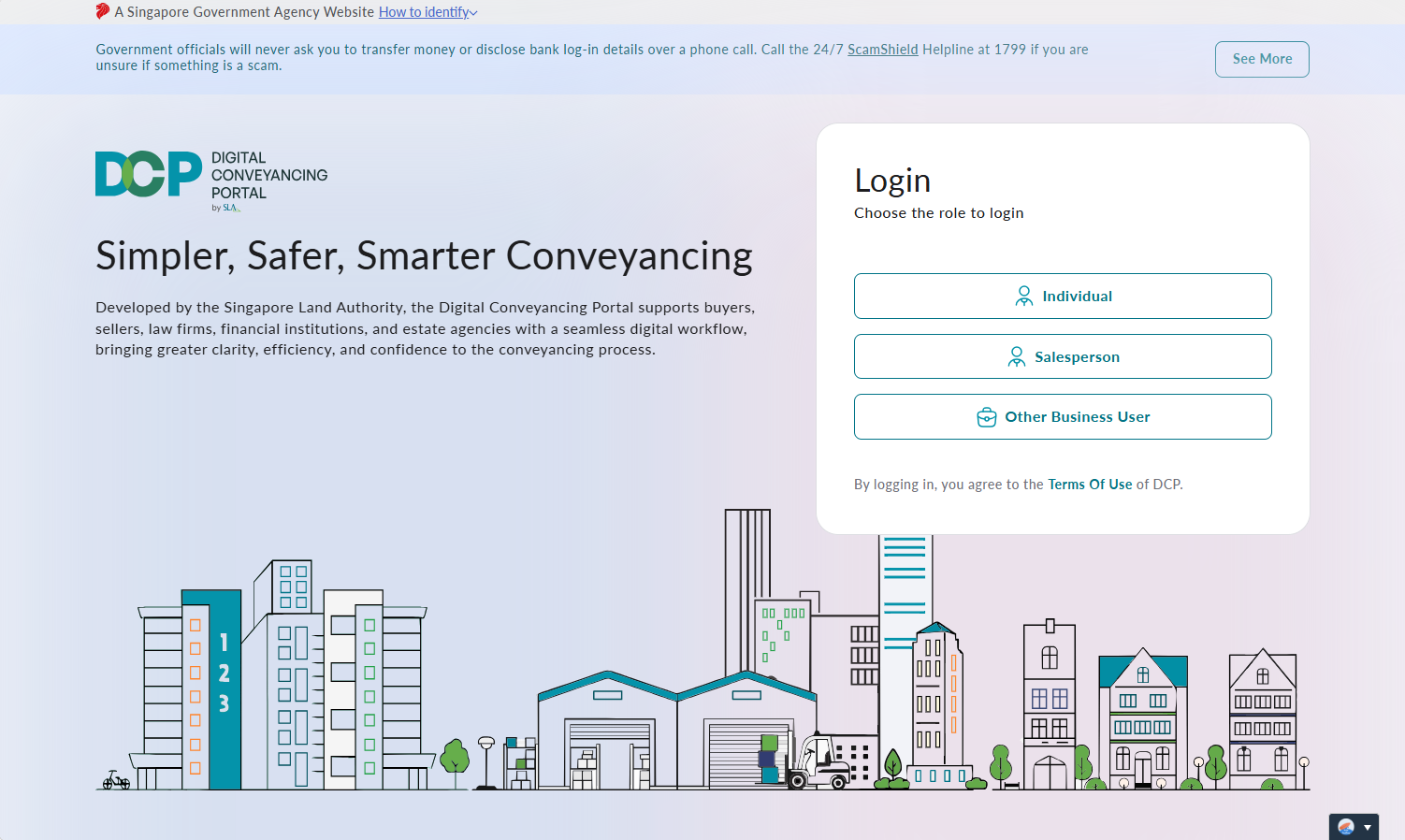
One portal, a more connected journey: DCP brings key conveyancing processes onto a common digital platform, starting with the Option to Purchase stage for eligible private residential resale transactions.
2. Who is DCP for?
Orson: DCP is for everyone who plays a part in a property transaction: conveyancing lawyers, property buyers and sellers, real estate agents, financial institutions and other government agencies. It's built for everyone, not just one group.
3. What can I use DCP for today? How does the DCP improve the process?
Siang Larng: Today's conveyancing process is long, largely paper-based, and runs on communication that isn't standardised across the different law firms, agencies and homebuyers involved. That can create operational friction: documents get physically couriered, status updates depend on someone picking up the phone, and buyers or sellers often have little independent visibility into where their transaction stands.
It's also a process with more risk baked in than most people realise. A manually prepared document, a missing or incomplete signature, or a cheque that goes astray can mean real delays, added costs, and unnecessary stress for people who are already navigating one of the biggest purchases of their life.
DCP is designed to close those gaps — reducing manual handling, standardising how information flows between parties, and giving everyone clearer visibility into where a transaction stands.— Foo Siang Larng, Director, Land Titles Registry, SLA

SLA officers review DCP's digital workflows as part of preparations for the pilot, with a focus on making property transactions more efficient, transparent and secure.
4. How does going digital affect my property transaction and ownership? How does the DCP keep my property transaction safe and secure?
Orson: Going digital does not change the legal fundamentals of buying or selling a property. The documents involved remain legally binding, and the conveyancing process involves similar key parties’ professional responsibilities.
What the DCP changes is how the transaction is carried out. Instead of relying on separate systems and manual processes, paper documents and multiple exchanges between parties, the DCP digitises and brings together key documentation and workflows on a common platform. It is about modernising the process around it — to make the conveyancing process more transparent, convenient and safe for everyone involved.
Security has therefore been a key consideration in the design of the DCP. Access to the portal is protected through Singpass and Corppass authentication, helping to ensure that users are identifiable and can only access transactions for which they are authorised. Only relevant professionals and institutions, such as licensed lawyers, licensed real estate agents and participating financial institutions, are onboarded onto the portal.
The DCP also supports secure digital processes, including digital signing, alongside cybersecurity safeguards such as data encryption and real-time monitoring of data access to detect suspicious activity. Importantly, bringing key transaction activities onto a common platform provides greater visibility across the conveyancing journey. Buyers and sellers, together with the lawyers, real estate agents and financial institutions involved in their transaction, can have clearer sight of key milestones and the progress of the transaction.
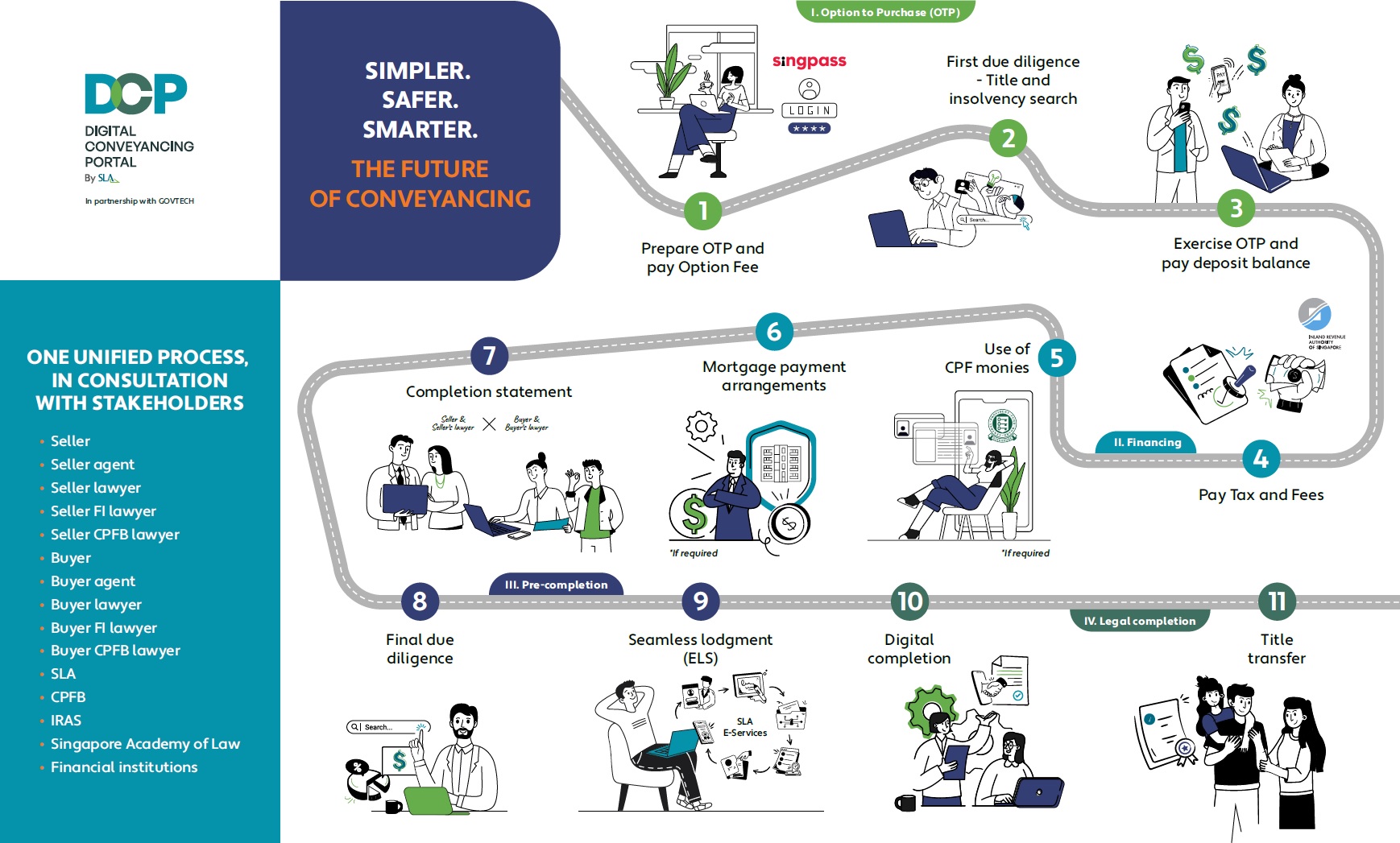
From option to ownership: A look at the different stages and stakeholders involved in a property transaction and how DCP aims to progressively connect them into a seamless digital journey.
The Digital Journey
5. What does the full conveyancing journey look like?
Siang Larng: Depending on the type of property transaction, conveyancing involves several stages, including: the OTP, where the buyer secures the right to purchase the property; financing, where the buyer arranges their loan; pre-completion, where legal checks and preparations take place; and legal completion, where ownership formally changes hands and final payments are made.
DCP is being rolled out progressively across these stages, rather than all at once. That's a deliberate choice. It lets SLA and its partners test, learn and refine the portal on a narrower scope before expanding it to the full journey.
6. What actually changes for someone going through an OTP through the DCP today?
Siang Larng: As this is a pilot launch, the DCP is not mandatory but serves as a platform for stages to be implemented before the process is fully digitalised.
For stakeholders who are first movers onboarded onto the DCP, the OTP stage is now digitalised. Relevant documents and information are handled through the portal rather than passed around individually, laying the groundwork for a more connected, transparent transaction.
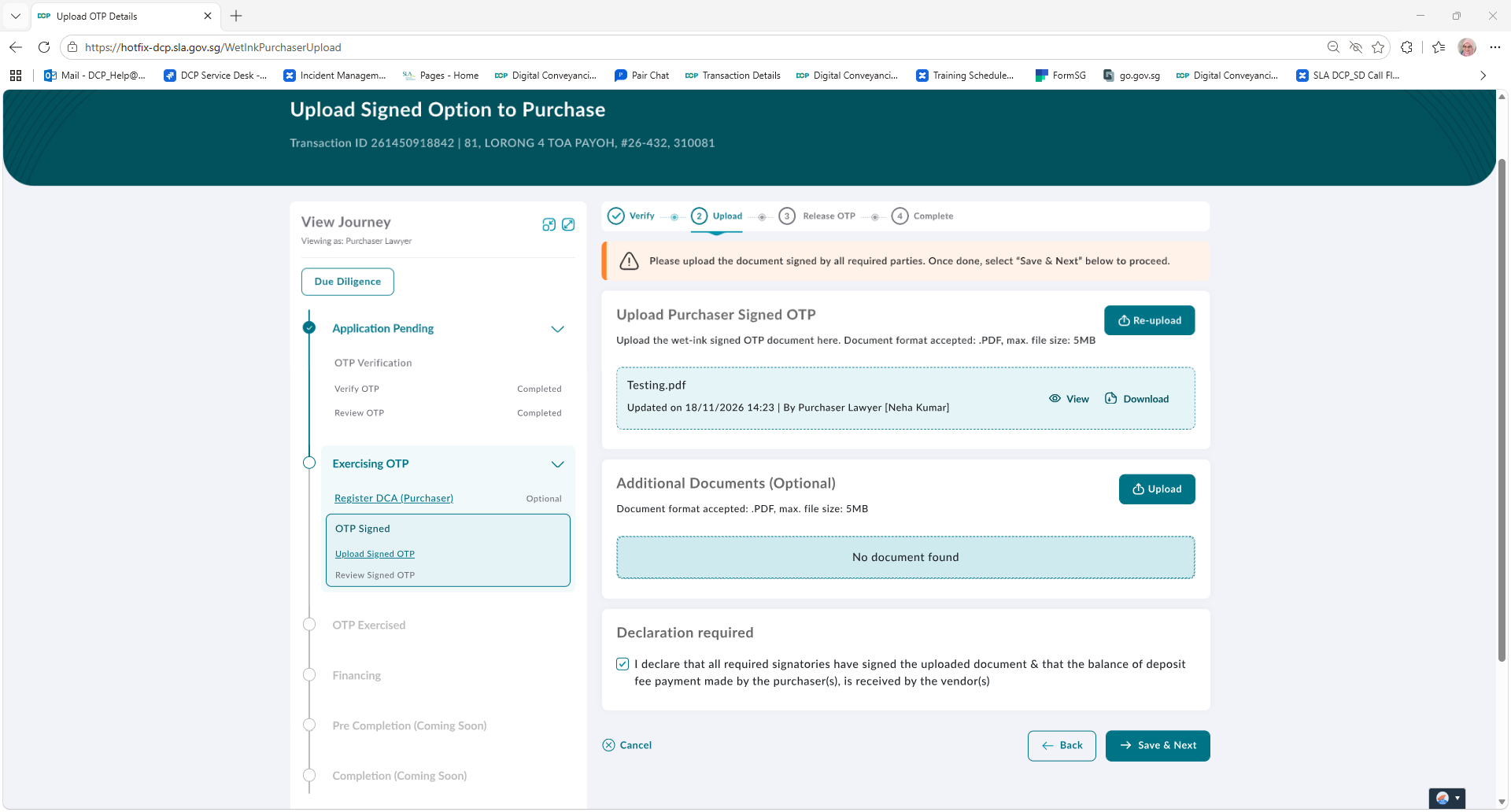
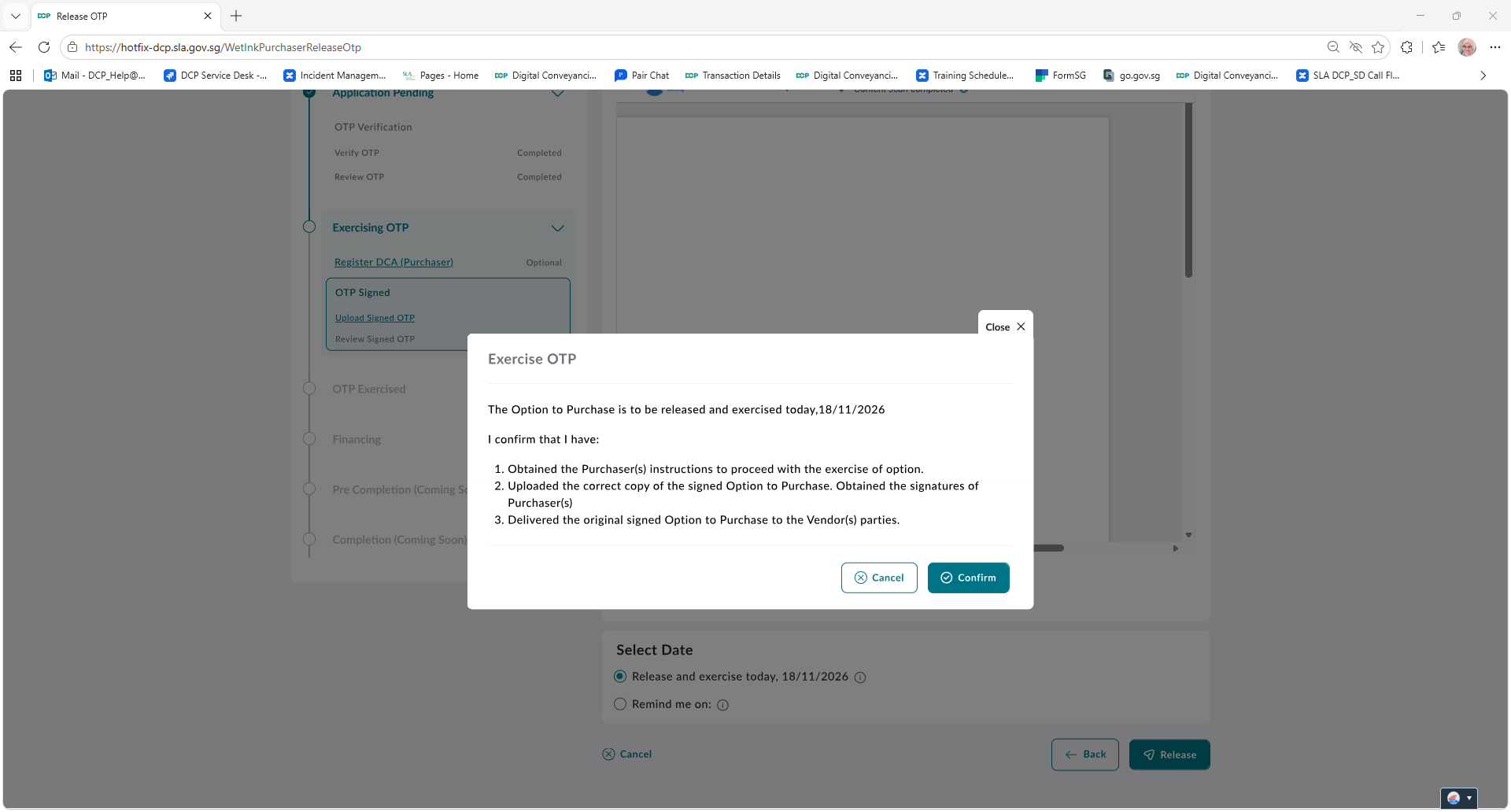
Sample screenshots of DCP OTP pages using a mock address, for illustration only. Only registered parties involved in a property transaction can access the relevant property details through Singpass/Corpass login
7. Why did DCP start with the OTP?
Siang Larng: The OTP is a natural starting point: it's the kick off for every property transaction, and it involves a well-defined set of parties and steps. This makes the introduction and scale of the DCP and the involvement of the stakeholders more manageable before we extend DCP to the more complex stages that follow. The pilot itself is limited in scope, working with a select group of law firms and estate agencies on real transactions, following an earlier beta test phase that used mock and small-value test transactions on the live system which proved successful.

Shaping the future together: SLA has been working closely with industry and government partners to develop DCP, gathering feedback and refining workflows to support a smoother transition to digital conveyancing.
8. Why is a pilot necessary?
Orson: A pilot is necessary because the DCP introduces a new, integrated way for multiple parties to carry out property transactions on a common digital platform. We took a considered approach by beginning with a defined group of participating law firms and estate agencies enables these stakeholders to be onboarded and supported closely, while ensuring that roles, workflows and operational arrangements are aligned from the outset.
The DCP is ready to move into a pilot now following several years of extensive engagement with industry and government stakeholders, and the successful completion of earlier preparatory phases in development. The core platform and the OTP workflow are in place, and participating law firms and estate agencies are ready to begin using them for actual private resale transactions.
The development of the DCP is a multi-agency effort involving consultations with both private and public sector stakeholders, such as Council of Estate Agencies (CEA), Singapore Academy of Law (SAL), Law Society, Real Estate Developers’ Association of Singapore (REDAS), Ministry of Law, Government Technology Agency, Housing Development Board (HDB), Urban Redevelopment Authority (URA), Central Provident Fund (CPF) Board and Inland Revenue Authority of Singapore (IRAS).
This focused first phase also allows the sector to start realising the benefits of a more connected, transparent and efficient digital process without waiting for every stage of conveyancing to be introduced at once. Starting with a defined group and the well-established OTP stage enables participating firms to be onboarded and supported closely, ensures workflows are aligned across all parties, and provides continuity in a measured manner alongside existing conveyancing arrangements. This measured first phase builds, minimising disruption for users and maintaining confidence and in property transactions. The experience gained will support stakeholder readiness across the industry, while laying a strong foundation for the DCP’s and inform the orderly expansion of the DCP to more participants, transaction stages and property types.
What the DCP changes is how the transaction is carried out. Instead of relying on separate systems and manual processes, paper documents and multiple exchanges between parties, the DCP digitises and brings together key documentation and workflows on a common platform. It is about modernising the process around it — to make the conveyancing process more transparent, convenient and safe for everyone involved.— Orson Zhu, Senior Deputy Director, Land Titles Registry, SLA
The Parties Involved
9. What does the DCP mean for lawyers?
Siang Larng: Conveyancing lawyers remain central to the process. DCP is designed to support their work, not replace it. What changes is how much of the manual and physicality of the work can be streamlined. With structured digital workflows, lawyers can expect fewer manual document preparation steps, improve visibility of transaction status, and easier coordination with the other parties involved — which in turn reduces the chances of human error during the process. In fact, in our engagements with young lawyers many welcome the move as they share this means they can now also have flexibility in alternative working arrangements that does not impact productivity.
10. What about buyers and sellers?
Orson: For buyers and sellers, the biggest shift is visibility, transparency and convenience. Where much of the behind-the-scenes coordination between law firms, agencies and banks has traditionally happened out of sight until they are surfaced, DCP gives users clearer visibility of the status of their own transaction, rather than waiting on updates second-hand.
Siang Larng: Another good thing about the DCP is that it allows payments to be made electronically as a lump sum, rather than through multiple physical cheques. This cuts down the hassle (and the risk of a cheque or cashier’s order going missing) for what is already a major life event. And to be clear: going digital doesn't mean going it alone. The process remains lawyer-assisted, with licensed conveyancing lawyers continuing to manage the legal work on your behalf.
11. And for real estate agents?
Orson: For property agents, DCP reduces touchpoints, eliminating repetitive data entry with a fill-once and fill-all process, and cut down back-and-forth co-ordination with lawyers and clients. With transparency of the transaction, agents can keep clients better informed while the transaction progresses.
12. Looking ahead, what will DCP mean for financial institutions?
Siang Larng: As DCP's later features bring full financing and completion stages onto the portal, financial institutions will also benefit through the streamlined process with standardised, trusted digital data. This means a reduction in the manual verification work currently needed and faster support for secure, digital payments. While the current pilot remains focused on the OTP stage and for private resale transactions, the future of DCP journey is promising, eventually expanding to all property types, from commercial to industrial.
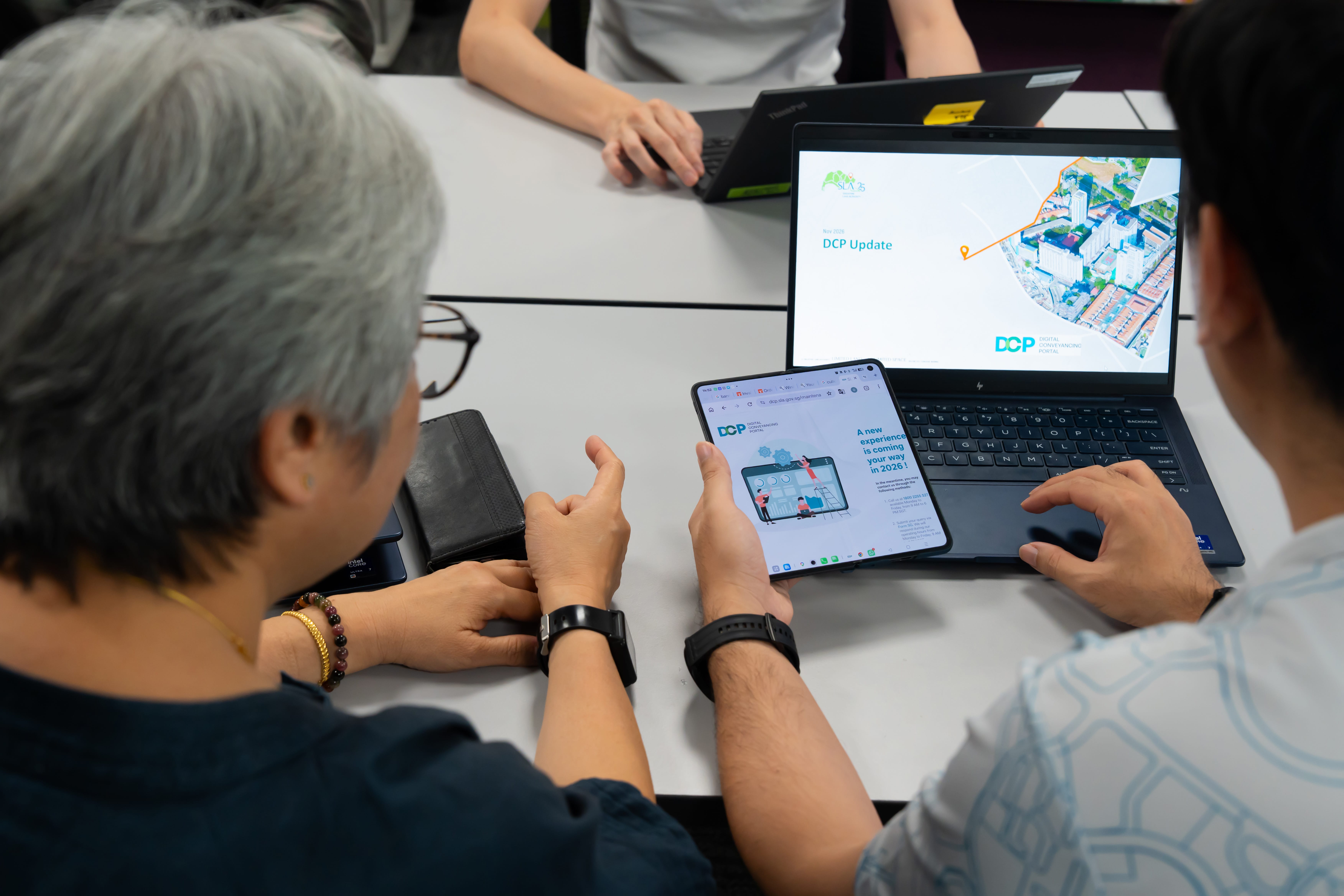
As of now, DCP is only available to participating law firms and real estate agencies handling private resale OTP transactions
Getting Started
13. Sounds great! How can I start using DCP?
Siang Larng: For now, DCP is available to participating law firms and real estate agencies handling private resale OTP transactions. If your conveyancing lawyer or agent is participating in the pilot, they'll be able to guide you through using the portal for your transaction.
So what’s next after the pilot?
Siang Larng: The pilot is the first step in a progressive rollout. By next year, DCP's public launch will include other features and other parts of the property purchase process, from pre-completion and legal completion stages, to support full digital payments across the entire transaction cycle. Over the next few years, DCP is set to progressively expand to cover the full end-to-end conveyancing journey, including developer sales, private commercial and industrial properties, and public residential markets.
Hear from the experts:
“The Digital Conveyancing Portal is a leap towards modernising how property transactions are carried out in Singapore. For legal practitioners, having key conveyancing processes on a single digital platform can reduce administrative friction and give us more time to focus on what matters most — providing sound legal advice and guiding clients through significant transactions. Its wider value is in working towards a more unified conveyancing ecosystem. With lawyers, financial institutions and other stakeholders working through a common platform, the objective is to move towards a more efficient, transparent and secure process.”— Mr Chua Shang Chai, Partner, Dentons Rodyk and Chairperson, Conveyancing Practice Committee, The Law Society of Singapore

For real estate agents, one of the most useful aspects of the Digital Conveyancing Portal will be having better visibility of where a transaction stands. Today, agents often have to check separately with clients or their lawyers for updates. Being able to track key transaction milestones through a common platform will help us stay informed, anticipate next steps and provide more timely updates to our clients. Beyond making our day-to-day work more efficient, the portal can help create a more connected property transaction journey. When agents, lawyers, financial institutions and other parties have clearer visibility of the process, there is less uncertainty and potentially fewer unnecessary follow-ups. Ultimately, this should translate into a smoother and more transparent experience for buyers and sellers.— Mr Lim Yong Hock, Key Executive Officer, PropNex Realty Pte Ltd